

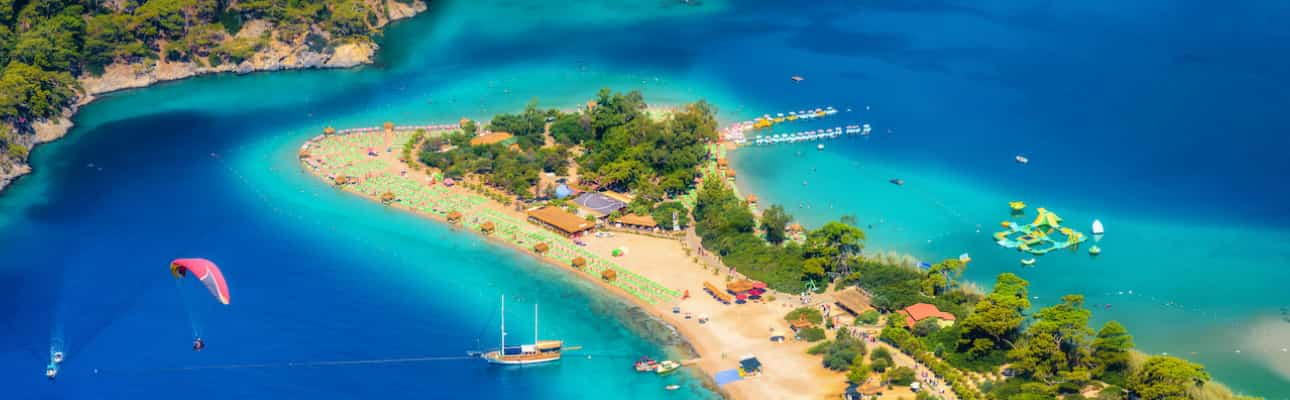

From rugged mountains and sun-soaked beaches to cobblestone alleys where tea flows like water and baklava hits like a hug from grandma—Turkiye’s got a bit of everything, and then some.
Best places to visit in Turkey
Istanbul
Cappadocia
Antalya
Pamukkale
Ephesus
Kas
When is the best time to visit Turkey?
Turkey is a year-round destination, but the best time to visit depends on your interests and the experiences you’re seeking. Here’s a seasonal breakdown to help you plan your trip:
Summer (June - August)
If you're a beach enthusiast, summer is perfect for enjoying Turkey's stunning coastlines. The Aegean and Mediterranean coasts offer sunny days and warm sea temperatures. However, be prepared for higher temperatures inland and larger tourist crowds in popular destinations.
Autumn (September - November)
Autumn is another excellent time to visit. The weather remains warm, especially in September, and the summer crowds begin to dwindle. This period is great for cultural festivals and exploring sites like Cappadocia, where the landscapes are particularly enchanting.
Summer (June - August)
If you're a beach enthusiast, summer is perfect for enjoying Turkey's stunning coastlines. The Aegean and Mediterranean coasts offer sunny days and warm sea temperatures. However, be prepared for higher temperatures inland and larger tourist crowds in popular destinations.
Winter (December - February)
For those interested in winter sports or experiencing Turkey's cultural sites without the crowds, winter offers a unique perspective. Ski resorts like Uludağ and Erciyes are popular, and cities like Istanbul have a quieter, more local feel. Keep in mind that some coastal resorts may have limited services during this season.
Frequently Asked Questions
What power plug type does Turkey have? Do I need a power adapter for Turkey?
Turkey uses the same two-prong round plugs you’ll find across much of Europe—Type C and Type F. If you’re coming from places like the US, UK, or Australia, your plugs won’t fit, so you’ll need a travel adapter. Also, keep in mind that Turkey runs on 230V at 50Hz. Most modern gadgets (like phones and laptops) are dual voltage, but double-check your gear. If your device only handles 110V, you’ll need a voltage converter to avoid frying it.
What is the main language spoken in Turkey, and do locals speak English?
The main language in Turkey is Turkish, and yep—it’s a whole different alphabet and sound. English isn’t super common everywhere, but in touristy spots like Istanbul, Cappadocia, or the coast, you’ll usually find someone who speaks enough to help you out. Outside the big hubs? Bring your charades game and learn a few Turkish basics—it goes a long way and locals appreciate the effort.
Here are some essentials to get you started:
Merhaba (mehr-HAH-bah) – Hello
A friendly greeting you can use anytime.
Nasılsın? (NAH-suhl-suhn) – How are you?
A common way to ask someone how they’re doing
Teşekkür ederim (teh-shehk-KOOR eh-deh-REEM) – Thank you
A polite way to express gratitude.
Lütfen (LOOT-fen) – Please
Adds politeness to any request.
Evet / Hayır (EH-vet / HAH-yuhr) – Yes / No
Basic affirmatives and negatives.
Afiyet olsun (ah-fee-YET OHL-soon) – Enjoy your meal
Commonly said before or during meals.
Güle güle (GOO-leh GOO-leh) – Goodbye
Used when someone is leaving.
Nerede…? (NEH-reh-deh…) – Where is…?
Essential for finding anything from the bathroom to the nearest kebab stand.
Ne kadar? (NEH kah-dahr?) – How much?
Perfect for markets and shops—just point and ask.
Hesap lütfen (heh-SAP LOOT-fen) – The bill, please
Use this when you’re ready to settle up at a restaurant.
Anlamıyorum (ahn-lah-muh-YOH-room) – I don’t understand
A polite way to indicate you’re not following the conversation.
Tuvalet nerede? (too-vah-LET NEH-reh-deh?) – Where’s the toilet?
A crucial question after indulging in Turkish tea.
Yardım eder misiniz? (YAHR-duhm eh-DEHR mee-see-niz?) – Can you help me?
Useful when you need assistance—Turks are generally helpful.
Afedersiniz (ah-feh-DAIR-sin-iz) – Excuse me / Sorry
Handy for getting someone’s attention or apologizing.
İngilizce biliyor musunuz? (in-gee-LEEZ-jeh bee-lee-YOHR moo-soo-NOOZ?) – Do you speak English?
A respectful way to check if someone can converse in English.
Pronunciation tip: Turkish is largely phonetic, so words are pronounced as they’re written. However, some letters have unique sounds:
Ç – Pronounced like “ch” in “chocolate”.
Ş – Pronounced like “sh” in “shoe”.
Ğ – This “soft g” lengthens the preceding vowel; it’s almost silent.
İ / I – “İ” is like “ee” in “see”; “I” (without the dot) is a unique sound, somewhat like “uh”.
What is the main religion in Turkey, and is it a secular country?
Turkey is officially a secular country, meaning there’s no state religion, and the government is separate from religious institutions. This secularism was established in the early 20th century under Mustafa Kemal Atatürk, aiming to modernize the nation and ensure freedom of religion and belief.
Despite this, Islam plays a significant role in Turkish society. The majority of the population identifies as Muslim, predominantly Sunni, with a notable Alevi minority. While the state maintains secular principles, religious practices and expressions are prevalent in daily life.
In recent years, discussions have arisen about the balance between secularism and religious influence in Turkey’s governance and society. Some observers note a trend towards increased visibility of religious elements in public life, sparking debates about the country’s secular identity.
For travelers, this means experiencing a unique blend of secular governance and rich religious traditions, offering insights into Turkey’s diverse cultural tapestry.
What is the currency used in Turkey, and can I pay with euros or dollars?
Turkey’s official currency is the Yeni Turkish Lira (TRY), symbolized as ₺. While some tourist-heavy areas, like parts of Istanbul or coastal resorts, might accept euros or U.S. dollars, it’s generally not advisable. Vendors often apply unfavorable exchange rates, meaning you’ll likely pay more than if you used lira. For the best value, it’s recommended to use Turkish Lira.
First off, avoid exchanging money at airports—the rates there are usually poor. Instead, head to licensed exchange offices (Döviz Bürosu) in city centers like Istanbul’s Taksim Square, Istiklal Street, or Sultanahmet. These spots often offer better rates and are easy to find .
Alternatively, ATMs from major banks like Halkbank, Garanti, or HSBC are widely available and can be a convenient option. Just be sure to use machines attached to bank branches to minimize the risk of skimming .
If you’re using a card, opt to be charged in Turkish Lira rather than your home currency to get a better exchange rate. And always avoid unlicensed street exchangers—they might offer tempting rates but can be risky.
Keep in mind that smaller establishments, markets, and rural areas may only accept cash, so having some lira on hand is practical.In summary, while euros and dollars might be accepted in certain tourist spots, using
Turkish Lira ensures smoother transactions and better value throughout your travels in Turkey.
Is it safe to drink tap water in Turkey?
Officially, Turkey’s tap water meets international safety standards. However, due to factors like old plumbing and chlorination, many locals and travelers prefer bottled water for its taste and to avoid potential stomach issues. In major cities like Istanbul, the water is generally safe, but it’s always a good idea to check with your accommodation. For brushing teeth and cooking, tap water is typically fine, but when in doubt, bottled water is a safer bet.
Isn’t Istanbul the capital of Turkey?
Ah, the classic mix-up! While Istanbul is Turkey’s largest and most famous city, the actual capital is Ankara. It’s like thinking Sydney is Australia’s capital when it’s actually Canberra, or assuming Toronto holds that title in Canada instead of Ottawa. These cities steal the spotlight, but the capitals quietly handle the official business.
Ankara, nestled right in the heart of the country might not have the coastal allure of Istanbul or Antalya, offers its own unique charm.
Ankara is a city where history and modernity intertwine. You can explore Anıtkabir, the impressive mausoleum of Mustafa Kemal Atatürk, the founder of modern Turkey. The Museum of Anatolian Civilizations showcases artifacts that span millennia, offering a deep dive into the region’s rich past.
The city’s Kocatepe Mosque stands as a testament to modern Islamic architecture, while the Ankara Castle provides panoramic views and a glimpse into the city’s ancient roots.
Do I need a visa for traveling in Turkey?
While travel insurance isn’t mandatory for all visitors to Turkey, it’s highly recommended. For travelers applying for a Turkish visa, especially for long-term stays, proof of travel insurance covering the duration of your stay is often required.
Even if you’re from a country that allows visa-free entry or e-Visa access, having travel insurance can be a lifesaver. It covers unexpected medical expenses, trip cancellations, lost luggage, and other unforeseen events that could otherwise lead to significant out-of-pocket costs.
So, while you might not be asked for proof of insurance at the border, having a comprehensive travel insurance policy ensures peace of mind during your Turkish adventure.
Why should you visit Turkey?
This vibrant country seamlessly blends ancient history with modern charm, offering something for every kind of explorer. Here are ten reasons why Turkey is a must-visit:
First off, Turkey’s historical heritage is nothing short of mesmerizing. Wander through ancient ruins like Ephesus and Troy, and you’ll feel like you’ve stepped back in time. These sites offer a glimpse into civilizations that have shaped our world.
Next, let’s talk about the food. Turkish cuisine is a feast for the senses. From savory kebabs to sweet baklava, every meal is an adventure. Don’t miss trying regional specialties like Gaziantep’s spicy dishes or the olive oil-rich meals of the Aegean coast.
The landscapes? Absolutely breathtaking. Experience the surreal beauty of Cappadocia’s fairy chimneys or relax on the pristine beaches of the Turkish Riviera. The country’s diverse landscapes are a nature lover’s paradise.
And the people? Turkish hospitality is renowned worldwide. Expect to be welcomed with open arms and perhaps a cup of traditional tea.
For accommodations, why not stay in a cave hotel in Cappadocia? These unique lodgings blend comfort with history, offering an unforgettable stay.
Immerse yourself in Turkish culture by visiting bustling bazaars, enjoying a traditional hammam, or witnessing the mesmerizing Whirling Dervishes. These experiences offer a glimpse into the country’s rich traditions.
Time your visit to coincide with local festivals. From music and film festivals to traditional celebrations, there’s always something happening.
Explore Turkey’s rich religious mosaic, from the grandeur of the Blue Mosque in Istanbul to the ancient Monastery of Sumela nestled in the cliffs of the Black Sea region.
For thrill-seekers, Turkey offers activities like hot air ballooning in Cappadocia, paragliding in Ölüdeniz, and hiking along the Lycian Way.
Whether you’re a history buff, a foodie, or an adventure enthusiast, Turkey promises an unforgettable journey.
Is traveling to Turkey safe?
Turkey is generally safe for travelers, especially in popular destinations like Istanbul, Cappadocia, and the coastal regions. These areas have enhanced security measures and are well-prepared to welcome tourists. However, it’s essential to stay informed about local conditions and exercise standard precautions. As with any travel, exercising common sense is key. Stay aware of your surroundings, avoid large gatherings or demonstrations, and keep an eye on local news and advisories.